Vision-Grounded Energy Critics for Physically Feasible Vision-and-Language Action Policies. Under review.
Overview
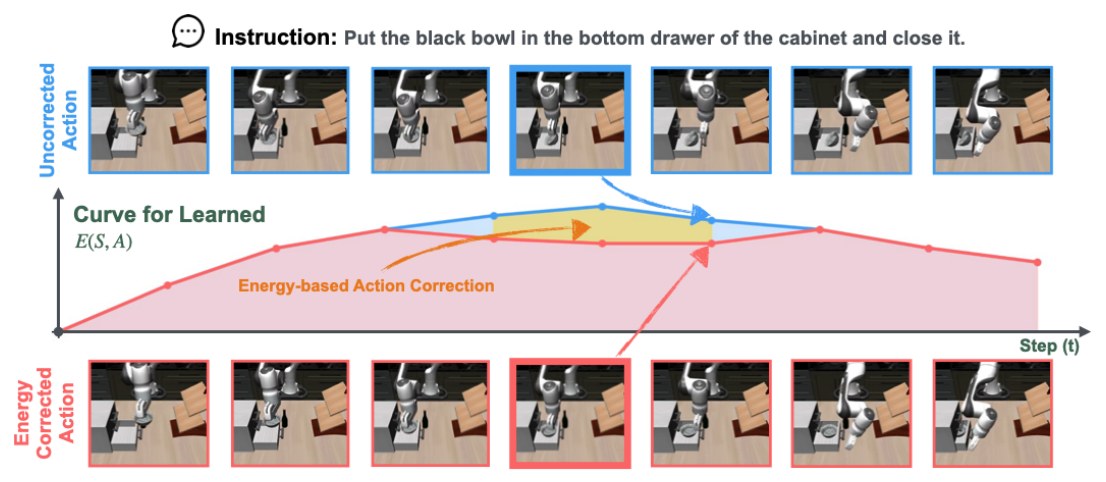
Vision-and-language action (VLA) models trained by behavior cloning map images and an instruction to robot actions, but they have no internal signal for whether an action fits the scene. A grasp that is slightly off, or a bowl placed one centimeter too close to a door, is executed as confidently as a good action. In long-horizon tasks such a small error can break every step that follows.
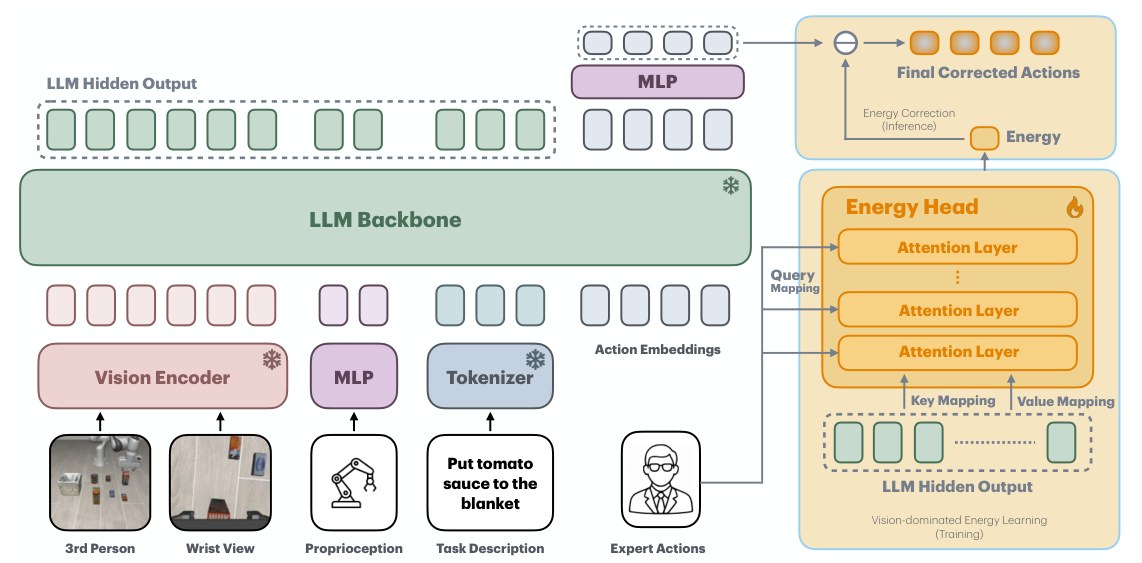
Vision-Dominated Energy Learning (VEL) adds a compact energy head to any frozen or fine-tuned VLA. The head maps the VLA’s hidden representation and a candidate action to a scalar energy, where lower energy means the action fits the scene better. It is trained with a contrastive objective on the demonstration data alone. At inference, one gradient step moves the proposed action toward lower energy. VEL needs no environment rollouts, no extra data and no change to the VLA backbone.
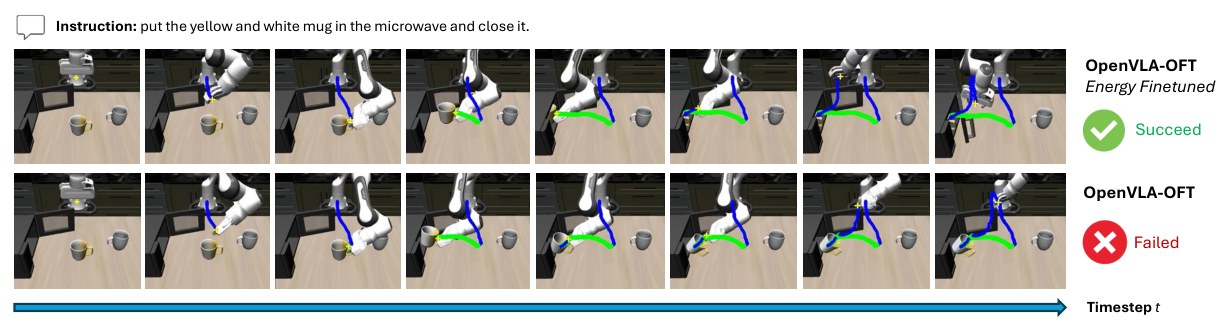
- On LIBERO-Long, VEL raises OpenVLA-OFT from 94.4% to 95.8% and π0.5 from 92.4% to 93.6%, removing 24% and 16% of the remaining failures.
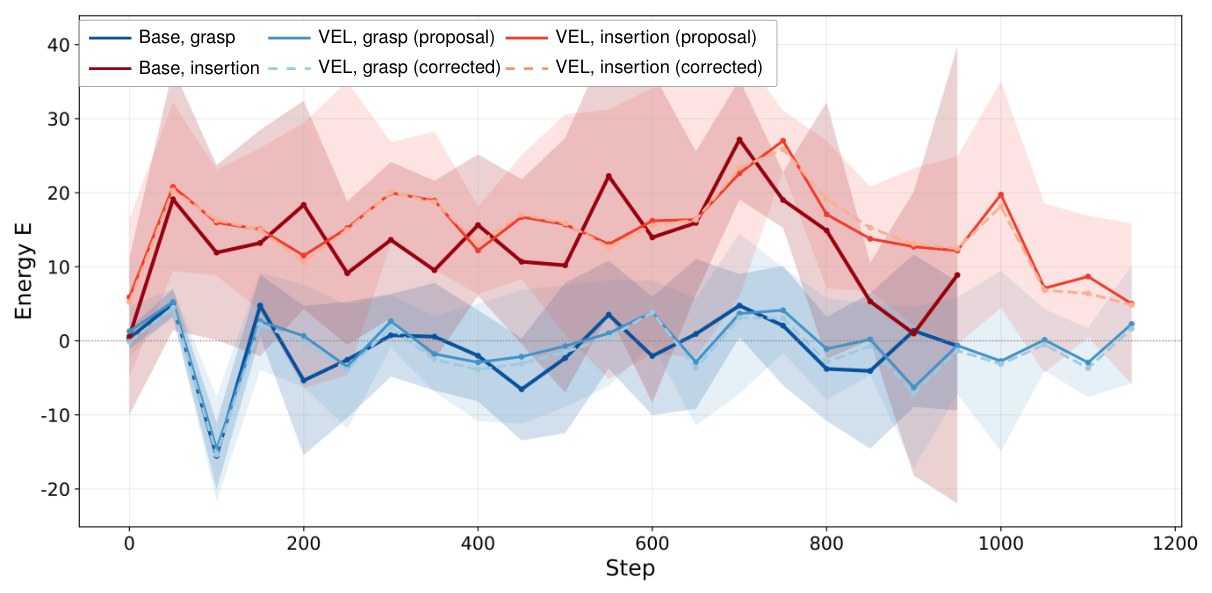
- On a real screw-insertion task with a π0.5 backbone, full-task success rises from 35% to 50%, and the gain comes from the precision-demanding insertion stage.
- The head adds fewer than 4.0M parameters and 4.61 GFLOPs per correction step, 0.4% over OpenVLA-OFT and 5.2% over π0.5.
Method
Why vision tokens
In representative VLA architectures, vision tokens make up over 85% of the last-layer hidden sequence and receive over 65% of the attention mass in the final decoder layer. This visual stream already encodes object poses, contact geometry and spatial relations, which is exactly the information that separates a feasible action from a subtly flawed one. VEL reads its energy from this hidden sequence.
Energy head
Two projectors map the hidden features \(h_t^{(-1)}\) to state tokens \(Z_h\) and the candidate action \(a_t\) to a single embedding \(z_a\). The action embedding then attends to the state tokens:
\[Z_h = P_h\big(h_t^{(-1)}\big), \quad z_a = P_a(a_t), \quad \tilde{z}_a = \mathrm{MHA}(Q = z_a,\ K = Z_h,\ V = Z_h)\]Using the action as the query lets it attend to the task-relevant regions of the scene. A SiLU feed-forward block and a linear readout turn \(\tilde{z}_a\) into a scalar energy. The tokens from which the backbone decodes its own action are masked, so the head judges the action against the scene and not against the backbone’s prediction.
Contrastive training
The head is trained with in-batch InfoNCE. For each state, its expert action is the positive and the actions of the other states in the batch are the negatives:
\[\mathcal{L}_{\mathrm{VEL}} = \frac{1}{B} \sum_{b=1}^{B} -\log \frac{\exp\big(-E_w(h_b, a_b^{+})/\tau\big)}{\sum_{j=1}^{B} \exp\big(-E_w(h_b, a_j)/\tau\big)}\]Gradients stop before the backbone, so only the head’s weights \(w\) are updated. At the population optimum the objective recovers the log density ratio between the conditional expert action distribution and the action marginal. Its action gradient is therefore the expert score minus the marginal score, which measures how well an action fits this particular state rather than how common it is overall.
One-step residual correction
At inference VEL takes a single gradient step from the behavior-cloned action and clips the result to the action bounds:
\[\tilde{a} = a_{BC} - \alpha\, \nabla_a E_w\big(h_t^{(-1)}, a_{BC}\big), \qquad a_{out} = \mathrm{clip}(\tilde{a}, -1, 1)\]Under local smoothness, this step is guaranteed to lower the learned energy. Only one step is taken on purpose: the energy is calibrated near the demonstrations, and further descent or search over it lowers the energy without improving the action. For action-chunking VLAs such as OpenVLA-OFT, each action in the chunk is corrected independently. For diffusion VLAs such as π0.5, the correction is applied to the final denoised action.
Results
LIBERO
Success rates (%) on LIBERO. VEL rows are mean ± std over five energy-head training seeds.
| Method | Spatial | Object | Goal | Long | Average |
|---|---|---|---|---|---|
| π0.5 | 98.8 | 98.2 | 98.0 | 92.4 | 96.8 |
| π0.5 + VEL | 98.2±0.4 | 97.6±0.8 | 98.3±0.5 | 93.6±0.6 | 97.0±0.2 |
| OpenVLA-OFT | 97.4 | 98.4 | 96.8 | 94.4 | 96.7 |
| OpenVLA-OFT + VEL | 97.9±0.9 | 98.2±1.7 | 97.5±0.8 | 95.8±0.9 | 97.3±0.3 |
The LIBERO-Long gains are significant for both backbones (p = 0.030 for OpenVLA-OFT, p = 0.011 for π0.5). The three shorter suites already run between 96.8% and 98.8% and show smaller changes of mixed sign.
What makes the gain
The gain could come from any test-time refinement, from the extra parameters, or from energy learning in general. Controlled comparisons on OpenVLA-OFT with the same backbone, data and step size rule these out:
| Method | Long | Average |
|---|---|---|
| OpenVLA-OFT (base) | 94.4 | 96.7 |
| + Best-of-N over the energy (noise injection) | 92.6±3.4 | 95.4±0.4 |
| + IBC-style CEM search over the energy | 91.8±2.8 | 94.5±0.7 |
| + Direct correction head, matched capacity | 69.6±0.5 | 84.9±0.4 |
| + Score-matching energy head | 92.8±1.0 | 96.7±0.5 |
| + VEL | 95.8±0.9 | 97.3±0.3 |
- Search over the same energy falls below the base policy. Replacing the base action discards the kinematics it established, and the deviation compounds over the episode.
- Extra capacity alone does not help. A regression head of the same size has to average over multimodal expert deviations and drops to 69.6% on LIBERO-Long.
- The contrastive objective matters. A score-matching head keeps a state-independent pull toward globally frequent actions and falls below the base on LIBERO-Long, while the contrastive field subtracts that term.
Real robot
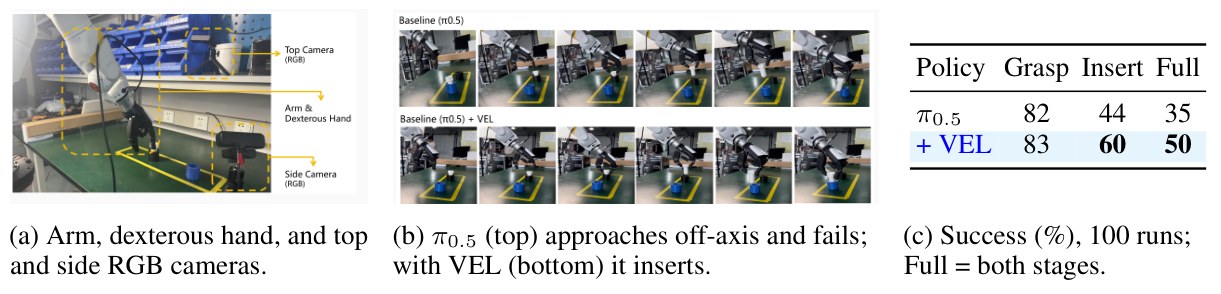
The setup is a Rokae xMate arm with an Inspire RH56 dexterous hand and two RGB cameras. The robot picks up a 3D-printed screw and inserts it into a base, a step that tolerates little positional error. π0.5 is fine-tuned on 300 teleoperated demonstrations, and the energy head is trained on the same demonstrations with the backbone frozen. Grasping is almost unchanged (82% vs 83%), while insertion rises from 44% to 60% and the full task from 35% to 50%. The episodes VEL recovers are those that grasped correctly and would have failed on the precise placement.
The learned energy
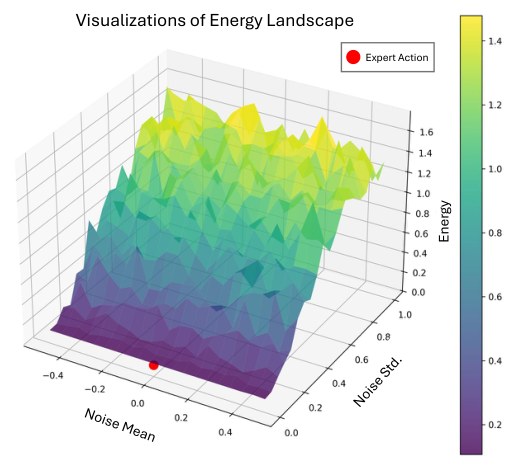
The energy surface forms a clear valley with the expert action at its minimum, and its magnitude grows with the ℓ1 distance to the expert action. Episode-level mean energy separates successful from failed LIBERO-Long episodes with an AUROC of 0.749. Under object perturbation on LIBERO-Spatial, VEL improves success by 3.4 points; under camera perturbation it gives no gain.
Inference cost
| Component | Latency (ms) | GFLOPs |
|---|---|---|
| OpenVLA-OFT | 103.3 | 1178.83 |
| + VEL | 106.4 | 1183.44 |
| π0.5 (co-located) | 80.2 | 88.92 |
| + VEL | 83.3 | 93.53 |
The energy head’s forward pass takes 0.7 ms and its gradient 2.4 ms, so one correction step adds about 3 ms on top of the backbone.
Conclusion
VEL is a backbone-agnostic energy critic that refines behavior-cloned actions with a single gradient step at inference. With under 4.0M parameters and a small fraction of the backbone’s compute, it removes about a quarter of the remaining long-horizon failures on LIBERO and raises real-robot screw insertion from 35% to 50%, which makes it a practical add-on for existing VLA pipelines.